Beyond Broadcast: Why Hybrid Satellite–IP Delivery is the Blueprint for Reliable Media Distribution

Sergio Ammirata Ph.D, founder and chief scientist, SipRadius,
Ciro Noronha PhD, CTO, Cobalt Digital
RF Transmission is the ideal way to send the same content simultaneously to a very large number of receivers. This is the original means of “broadcasting”, with which content is sent by one sender to many receivers. New receivers just need to put up an antenna, and they can start receiving content straight away.
TV and radio still work like this for a given geographical region, and geosynchronous satellites do the same thing for continental areas. In all of these cases, the transmission is unidirectional, and there is no return path.
Nowadays, we of course also have the internet. It’s not as easy to connect to as putting up an antenna, and not as widely available, but it’s getting there. When compared to traditional broadcast, one key difference is that the internet is unicast. If you want to send the same content to multiple receivers, you must send an individual copy to each receiver. At the protocol layer, the ability to transmit content from one sender to multiple destinations and have the network replicate has existed since 1989, when RFC 1112 (IP Multicasting) was published. While some “islands” on the internet do support IP Multicasting, this is still not in general use and is not likely to be so in the foreseeable future.
Comparing RF Transmission and Internet Distribution
As with most things in life, neither RF nor internet distribution are problem free in every respect. Both have their issues.
RF for example is subject to interference. In satellite, C-Band is very reliable, but the spectrum is being re-allocated to cellular services, and in some areas of the world (including the United States), it may disappear completely in the near future. K-Band satellites have a lot of bandwidth available, but due to the higher frequencies involved, the transmission suffers from rain fade. Under heavy rain, the signal may disappear completely. Terrestrial TV transmissions can also be blocked by line-of-sight interference, especially if the receiver is moving.
Transmission over the internet cannot be scaled as easily as with RF. It costs money and bandwidth resources for each receiver added. Additionally, Internet traffic is also often subject to congestion, which causes packet losses and other undesirable effects.
The sensible question to ask is, can we combine these two technologies (RF and internet) to get the best of both worlds?
The answer is yes, absolutely. Satellite (or any other RF distribution method) can be used for the heavy lifting, and the internet can be used to fill in the blanks, recovering the data that was not correctly received. This minimizes the amount of traffic that uses the internet, reducing transmission costs and bandwidth constraints.
Hybrid Satellite and Internet
The Reliable Internet Stream Transport (RIST) Activity Group has been addressing this very issue. It recently published a Technical Recommendation providing a common specification for combining satellite and internet to provide a reliable delivery service. This operation is defined in the Video Services Forum Technical Recommendation TR-06-4 Part 7 and is outlined in the following diagram.
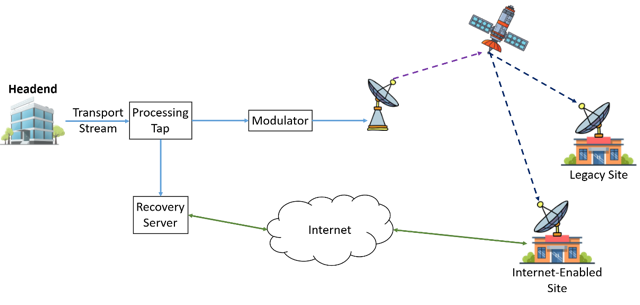
As the diagram shows, a processing tap is inserted between the headend and the satellite uplink. It inserts backward-compatible metadata that allows a compatible receiver to re-create a RIST RTP stream from the transport stream. Legacy receivers simply ignore this metadata.
When compatible receivers note lost data in the RF segment, they can use this metadata to identify missing data, and request resends over the internet. The Technical Recommendation also includes a mechanism to request the full stream in case of a complete RF fade. The metadata overhead is small (typically less than 2% of the feed bandwidth) and can be injected by re-using NULL packets.
In a typical deployment, the recovery server will be a load-balanced bank of servers. Moreover, since the metadata contains instructions on how to re-create the RTP stream, this same RTP stream can be sent from the headend to a fleet of servers that are geographically located close to a group of receivers. This reduces the internet bandwidth requirements at the headend location.
This architecture is clearly laid out in the documentation, which fully defines the requirements. What is important to understand is that this is not purely theoretical: it is a fully worked practical solution that is already in commercial service. A description of one such implementation will illustrate the system in action.
Practical Implementation in Tropical Barbados
Caritech Solutions, a registered ISP, networking and telecommunications company, based in Barbados, first adopted RIST as the foundation of its production workflows, as a means of delivering content securely and reliably via networks outside of its control. As a provider of a DTH Ku-band service in a tropical region which suffers from intermittent but very heavy rain, rain fade is obviously a significant issue for its service delivery. Traditional solutions have specified larger receiver dishes or very expensive, very high performance LNBs to achieve sufficient signal-to-noise headrooms. However, these types of solutions are often not practical or financially viable, nor completely successful, and even if they were, brute force engineering is not a realistic, long-term solution.
Instead, Caritech Solutions investigated the possibility of implementing a proof-of-concept TR06 Part 7 hybrid satellite/internet RIST solution to support its DTH Ku-band service.
To achieve this, Caritech worked with SipRadius, a key contributor to the creation and ongoing evolution of the RIST standard, to define a core architecture. It included: a multi-transponder RIST sender infrastructure to manage satellite uplinks; hybrid receivers that seamlessly switch between satellite and internet recovery; a real-time monitoring dashboard to track system health across the deployment; and an automated fast stream recovery system with intelligent failover.
As defined in the Technical Recommendation, the system embeds metadata markers directly into the satellite transport stream, which create synchronization points allowing receivers to identify precisely which packets were lost or corrupted in the satellite delivery. The metadata allows intelligence in the receiver to request the exact packets needed to patch the stream: no more, no less, in order to minimize the internet bandwidth demand.
The underlying software includes advanced configuration, which provides full control over the RIST profiles, and encryption using AES-128 and AES-256. Efficiency is maintained through buffer sizing and NULL packet deletion.
The designers took the opportunity to also use the same platform to develop receiver tracking functionality for enhanced intelligence. Supporting thousands of receivers, this provides search, filtering and detailed per-receiver metrics, including bandwidth, RTT, packet loss and signal quality.
The technical stack includes: PHP backend managing RIST sender processes and configuration; RESTful API for all transport operations; realtime WebSocket connection for live updates; Prometheus integration for detailed metrics collection; and JSON-based configuration management for flexibility.
Proof is in the Pudding
The success of the Caritech system demonstrates the efficacy and simplicity of the RIST hybrid satellite IP Technical Recommendation. If operating under normal conditions when rain is not affecting the satellite signal, all receivers carry on pulling content from the satellite as usual. But the moment that rain becomes a problem, causing packets to be lost, with this system, the receivers are able to automatically detect those missing packets and then request the specific missing RTP sequence numbers from the internet recovery server. In the event that extreme weather hits and the satellite signal is lost completely, the system will switch to RIST-only streaming until the signal is stable again.
The beauty of the RIST intelligent packet switching system is that it is incredibly efficient and it all happens behind the scenes, so the viewer’s experience is not interrupted in any way.
Extensive testing of the platform shows that under normal conditions the internet bandwidth usage is negligible: heartbeats and status updates. During a rain fade event, automatic failover happens in milliseconds. The nature of RIST streaming means that recovery bandwidth is on a per receiver basis, so each only requests and receives just the missing packets. The outcome is demonstrated to show no buffering, no quality reduction, and no viewer impact in testing.
What the Caritech system demonstrates is that the intelligent packet recovery mechanism built into RIST is incredibly efficient, providing robust recovery even in edge cases. It has also showed that the economics work as predicted. Smaller dish sizes are now practical, reducing costs and installation complexity.
Additionally, by building intelligence into its architecture, key functionality like load-balancing is inherent and automatic for Caritech. So too, is maintaining technical supervision of receivers, to ensure every device is performing correctly and is running updated software. Any issues can also be troubleshooted remotely which allows problems to be fixed as soon as they are identified.
Looking to the Future
The Caritech system demonstrates that the hybrid satellite/internet RIST delivery is a robust solution for cost-effective, widespread satellite distribution. Additionally, as we look at how this hybrid delivery mechanism maybe deployed across the industry, there is also potential to add emerging technologies into these types of workflows in a seamless way. Dynamic ad insertion is an excellent example, using subscriber data and internet distribution to present appropriate advertising based on accurate receiver location and viewing patterns. As well as an enhanced source of revenue for the broadcaster, the ability to show commercials that are of real interest to individuals retains their interest, reducing the likelihood that viewers will disengage during the ads.
Clearly, the challenge in taking this proven technology to large-scale roll-out is the need for consumer electronics manufacturers to develop practical, affordable hardware to be rolled out at scale. This and other fully worked systems clearly demonstrate not just the viability but the value of this solution, so we therefore urge vendors to move to deliverable hardware as quickly as possible.
The RIST Activity Group is responsible for continually enhancing and further developing RIST specifications. It’s currently working on two additional Technical Recommendations: TR-06-4 Part 8 will be like Part 7 but will not include any metadata in the Transport Stream; and TR-06-4 Part 9 will address RF systems that are IP-based rather than Transport Stream-based, such as ATSC 3.0.
In the meantime, hybrid satellite/internet RIST delivery as defined in VSF TR06 part 7 is proven, and its ready, so let’s go!