Firefly Aerospace Accelerates Spacecraft Production with Expanded Campus and Innovation Lab in Central Texas
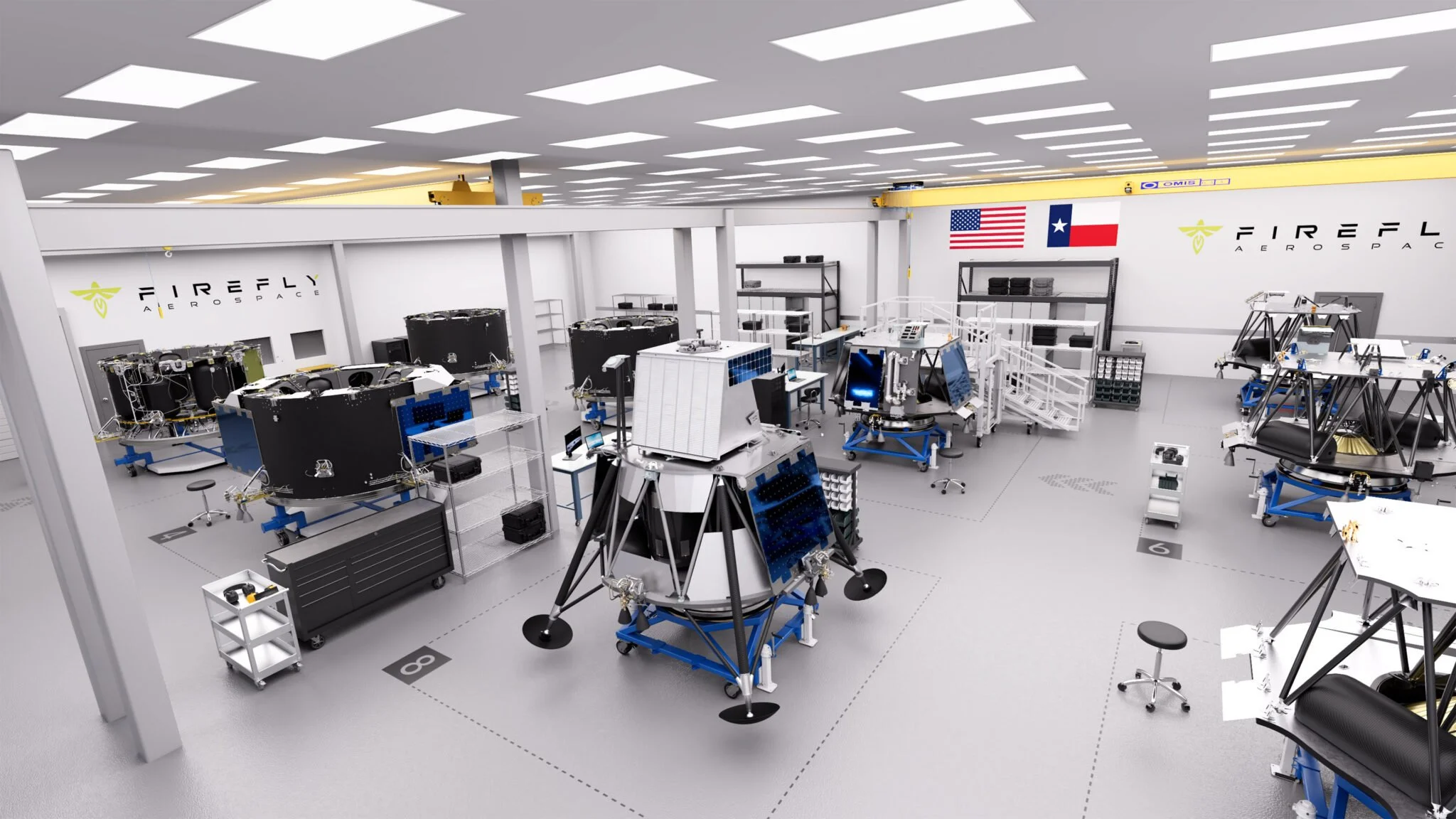
Rendering of Firefly’s new cleanroom at its spacecraft facility in Cedar Park, Texas Credit: Firefly Aerospace
Firefly Aerospace (Nasdaq: FLY), a market leading space and defense technology company, announced the company moved into a new headquarters, expanded its cleanroom space, and added an innovation lab to support Firefly’s growing workforce, accelerate spacecraft production, and enable breakthrough space technologies.
The expansion includes two new buildings adjacent to Firefly’s existing spacecraft facility in Cedar Park, Texas, enabling one robust campus with 144,000 total square feet for spacecraft assembly and testing, mission control, avionics and component production, engineering, and business operations. The new campus is twice the size of Firefly’s former Cedar Park facilities and is less than 30 miles from Firefly’s 200-acre Rocket Ranch in Briggs, Texas, where the company operates six test stands and 217,000 square feet of facilities for launch vehicle engineering, manufacturing, and integration.
“With operations centralized in Texas, Firefly is producing rockets and spacecraft at scale to meet the demand of the rapidly growing defense, exploration, and commercial space markets,” said Ramon Sanchez, COO of Firefly Aerospace. “The strategic investments we’ve made in our Cedar Park campus allow us to template our successful Blue Ghost lunar lander into a production line for multiple lunar missions a year that support NASA’s Moon Base initiative and the larger commercial lunar economy.”
As part of the expanded campus, Firefly has made significant progress on a new cleanroom that is four times the size of its existing cleanroom. Funded by a Texas Space Commission grant, the new cleanroom enables a dedicated assembly line of Firefly’s Blue Ghost lunar landers and Elytra orbital vehicles.
Firefly’s new innovation lab, called Gloworks, further enables rapid technology innovation in key areas, such as propulsion, carbon composites, robotics, and 3D printing. This emergent-work lab is utilized to enhance the capabilities of Firefly’s launch, lunar, and orbital vehicles and break into new categories that align with the growing needs of Firefly’s diverse customers. The lab houses high-tech machinery, including 3D and titanium printers, plasma cutters, composite fabrication, welding, and automated milling machines.
“Gloworks allows us to amplify our rapid, innovative mindset to tackle the problems of the future, including everything from surviving the lunar night to efficiently deorbiting spacecraft that reach end of life,” said Shea Ferring, Chief Technology Officer at Firefly Aerospace. “This lab is the incubator driving key space technologies and differentiators that disrupt the future without disrupting our existing production line.”
Firefly is also making vast improvements to its Rocket Ranch and recently added two new mezzanines for an additional 30,000 square feet of engineering and manufacturing workspace. The company is further making continuous upgrades to its automated carbon composite and propulsion machinery as well as improvements in its production and integration workflow for enhanced quality and scalability.
Additional upgrades are being made to Firefly’s Eclipse engine test stand to support multiple engines on the stand at once and increase testing cadence. Alpha’s stage test stand is also getting enhancements to streamline test operations and improve ground system reliability.