Rocket Lab Awarded $397 Million Contract to Build and Launch Flatellites for U.S. Space Force’s Space-Based Airborne Moving Target Indicator Program
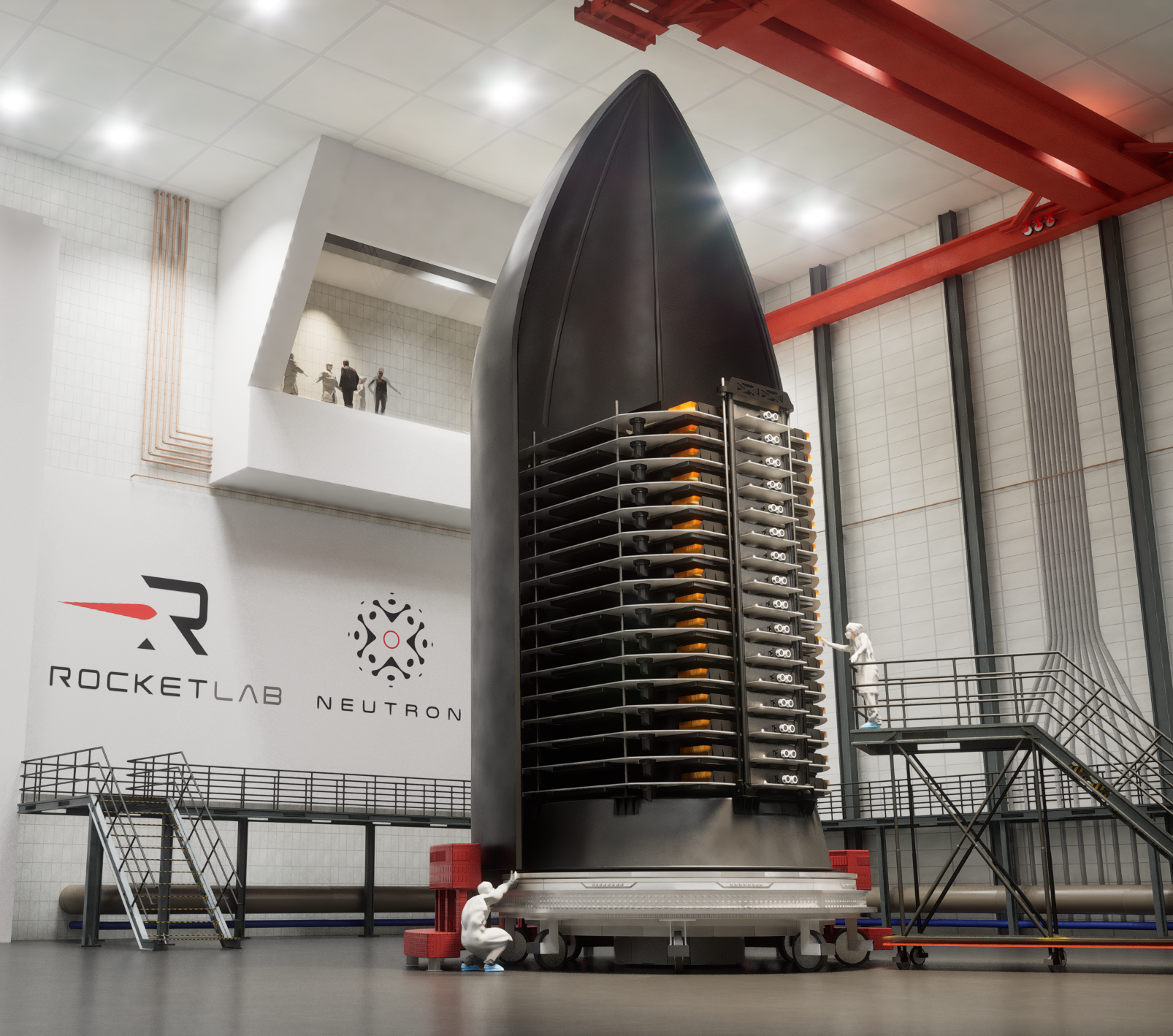
Artist impression of Rocket Lab Flatellite spacecraft inside a Neutron launch vehicle fairing
Rocket Lab Corporation (Nasdaq: RKLB), a global leader in launch services and space systems, announced it has been awarded a $397 million contract by the United States Space Force under the Space-Based Airborne Moving Target Indicator (SB-AMTI) program. The initiative, led by the Portfolio Acquisition Executive (PAE) for Space-Based Sensing and Targeting (SBST), aims to enhance global security by deploying a resilient space-based system to detect and track airborne threats in real time.
Under the contract, Rocket Lab will develop, launch, and operate multiple advanced Flatellites — a next-generation flat satellite design optimized for large constellations — with space-based sensors and low latency, high bandwidth communication links. Rocket Lab will launch the Flatellites on the Company’s upcoming Neutron rocket and operate them from secure facilities, providing data and track information to the Space Force. An option for additional Flatellites is included in the total contract value. The Flatellite spacecraft and Neutron launch service will enable vendor diversity in the SB-AMTI program and increased capabilities for deploying the SB-AMTI architecture, which integrates cutting-edge sensors, secure communications, and robust ground processing systems to provide the U.S. military with persistent, real-time battlespace awareness in contested environments.
By integrating launch, spacecraft, and mission operations, the contract award is a strong recognition of Rocket Lab’s strategic vertical integration model that delivers rare end-to-end space capabilities.
“Rocket Lab is honored to play a key role in the SB-AMTI program, which is critical to expanding the Space Force’s layered, resilient tracking architecture,” said Sir Peter Beck, Rocket Lab founder and CEO. “Our vertically integrated, constellation-class satellite capabilities, mission operations, and launch services uniquely position us to deliver innovative solutions that meet the urgent needs of the Space Force. We are proud to contribute to the deployment of a resilient space-based sensing layer that will enhance the Joint Force’s ability to operate in contested airspace.”
Rocket Lab’s selection builds on its proven track record of supporting U.S. government and defense initiatives, including successful missions for the Space Force, National Reconnaissance Office, DARPA, and NASA. With its vertically integrated approach — spanning satellite design, manufacturing, launch, and on-orbit operations — Rocket Lab ensures the rapid and reliable delivery of critical space systems.
About SB-AMTI
For decades, the military has relied heavily on terrestrial and airborne sensors to track moving targets in the air. However, deploying these traditional sensing aircraft into highly contested environments is becoming increasingly unviable, as those platforms face unprecedented risks from increasingly sophisticated anti-access/area-denial systems. Spearheaded by the Portfolio Acquisition Executive (PAE) for Space-Based Sensing and Targeting (SBST), this ambitious initiative is designed to provide the Joint Force with persistent vigilance over the battlefield, tracking airborne threats continuously from space.
Designed as a complex "system-of-systems," SB-AMTI isn't just a single satellite. It is a highly integrated architecture encompassing advanced space-based sensors, artificial intelligence-driven resilient ground processing and secure communication links. By leveraging AI to filter clutter and identify targets hidden within massive data streams, the ultimate goal is to provide warfighters with continuous oversight and real-time tracking data, eliminating operational blind spots regardless of what is happening in the airspace below.