Rocket Lab Unveils New Electric Propulsion Satellite Thruster to Meet Constellation Demand
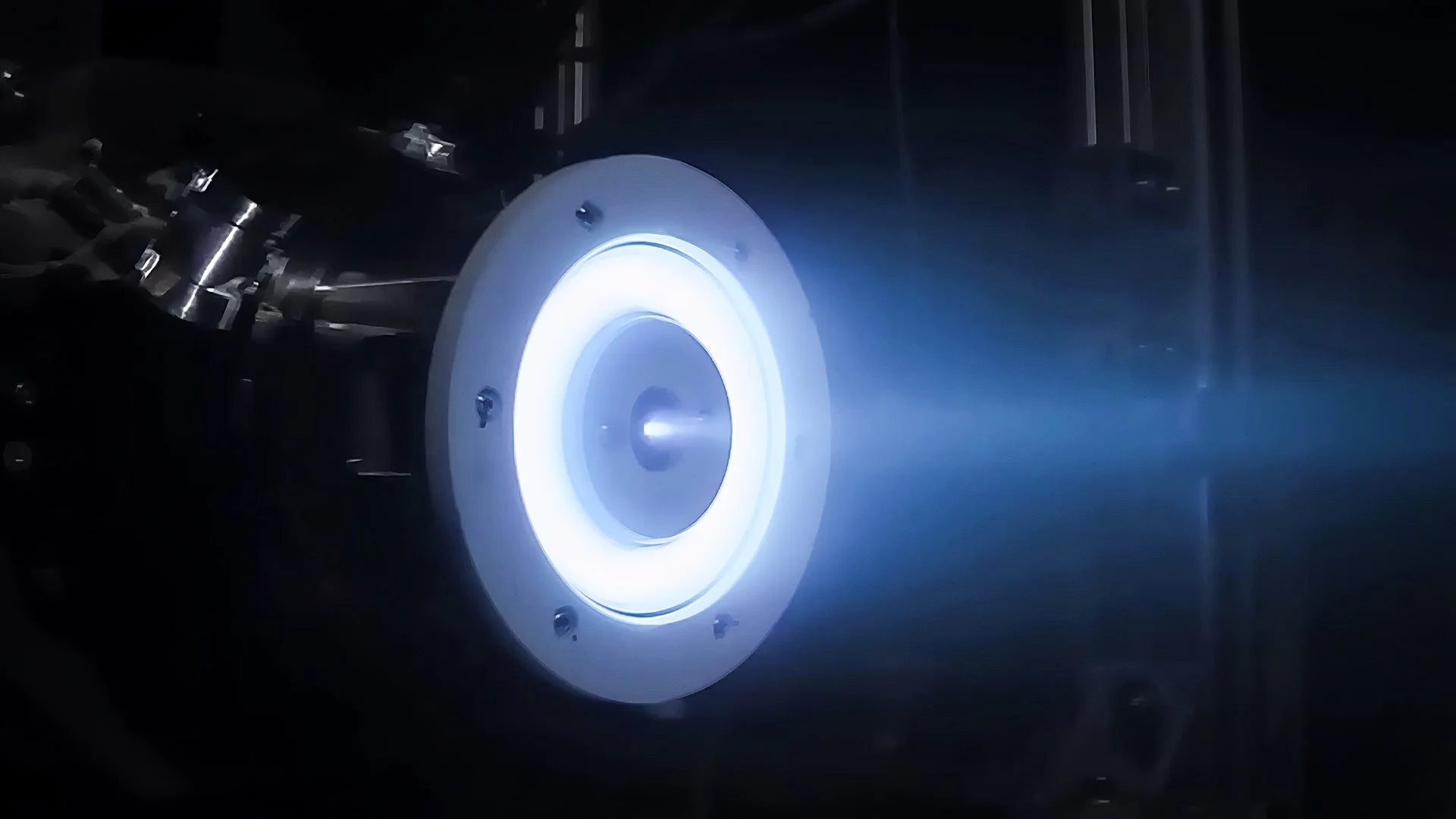
Rocket Lab Corporation (Nasdaq: RKLB) (“Rocket Lab” or the “Company”), a global leader in launch services and space systems, today introduced a new electric satellite thruster designed for high-volume production to meet the growing demand for reliable satellite propulsion across commercial and national security constellations.
Rocket Lab’s in-house designed and manufactured electric propulsion system, named Gauss, features a Hall Thruster, Power Processing Unit and a Propellant Management Assembly. Recognizing the importance of not only bringing a new high-performance electric propulsion system to market, but also making it reliably available at scale, Rocket Lab has already established a high-volume Gauss production line designed to produce more than 200 thrusters per year, ensuring the Company can supply thrusters on demand in large quantities. Electric propulsion thrusters have historically proven extremely difficult to produce in high volumes, causing supply chain fragility for national security and commercial constellation operators alike. Rocket Lab has leveraged extensive propulsion experience, as well as the proven ability to manufacture critical satellite subsystems in high volumes, to finally deliver an electric propulsion solution in the rapidly growing quantities needed by the global space industry.
Rocket Lab founder and CEO, Sir Peter Beck, said: “Proliferated constellations are now the norm for commercial and national security space users, but the propulsion systems needed to maneuver these spacecraft in orbit have simply not been reliably available at any kind of scale. Rocket Lab is solving this bottleneck with Gauss. We’ve successfully scaled other satellite components to thousands of units per year to meet the market’s needs for volume and speed, now we’re giving electric satellite propulsion the same treatment.”
The Gauss thruster is designed to produce a higher specific impulse compared to traditional chemical propulsion systems, enabling it to produce more thrust per unit of propellant and making it more efficient for long-duration missions. Because of this high efficiency, the Gauss thruster will allow spacecraft to carry less propellant while still achieving high performance, making it ideal for prolonged missions, such as deep space exploration, and satellite station-keeping within constellations.
In naming the thruster after Carl Friedrich Gauss, Rocket Lab continues a long tradition of naming rocket and spacecraft engines after renowned physicists. The Gauss thruster joins Rocket Lab’s existing suite of propulsion systems including the Electron rocket’s Rutherford engine, the Neutron rocket’s Archimedes engine, and the Electron Kick Stage’s Curie engine.
Rocket Lab’s Chief Engineer of Special Projects, Shaun O’Donnell, added: “When we identify a supply chain constraint affecting our customers and indeed the wider global space industry, we often look to acquire existing technologies that are high-performing but have struggled to scale production. We explored this as an option for Gauss but ultimately determined we could build the best, high-performance product in house and scale it to meet industry needs ourselves. Propulsion is, after all, embedded in Rocket Lab’s DNA. With Rutherford we built the world’s first 3D printed orbital rocket engine and have now launched 850 of them to space. Our Curie engines have provided precision maneuverability to enable the successful deployment of more than 200 spacecraft in orbit, including enabling a mission to the Moon and powering innovative Earth re-entry missions. Gauss is the next major step in Rocket Lab’s extensive propulsion heritage and a key enabler of the constellations we build for our customers, and for ourselves.”
Key Gauss Features:
Heaterless cathode technology enabling instantaneous start.
Magnetic shielding reduces erosion and extends lifetime to support long duration missions.
Efficient GaNFet based electronics for optimized performance.
Simple software command interface eliminates complex PPU parameter management.
ITAR/EAR-free design well suited for wide range of LEO constellation applications.
Xenon propellant (Krypton also possible)