SES Taps K2 Space to Accelerate Next-Gen MEO Satellite Network, meoSphere
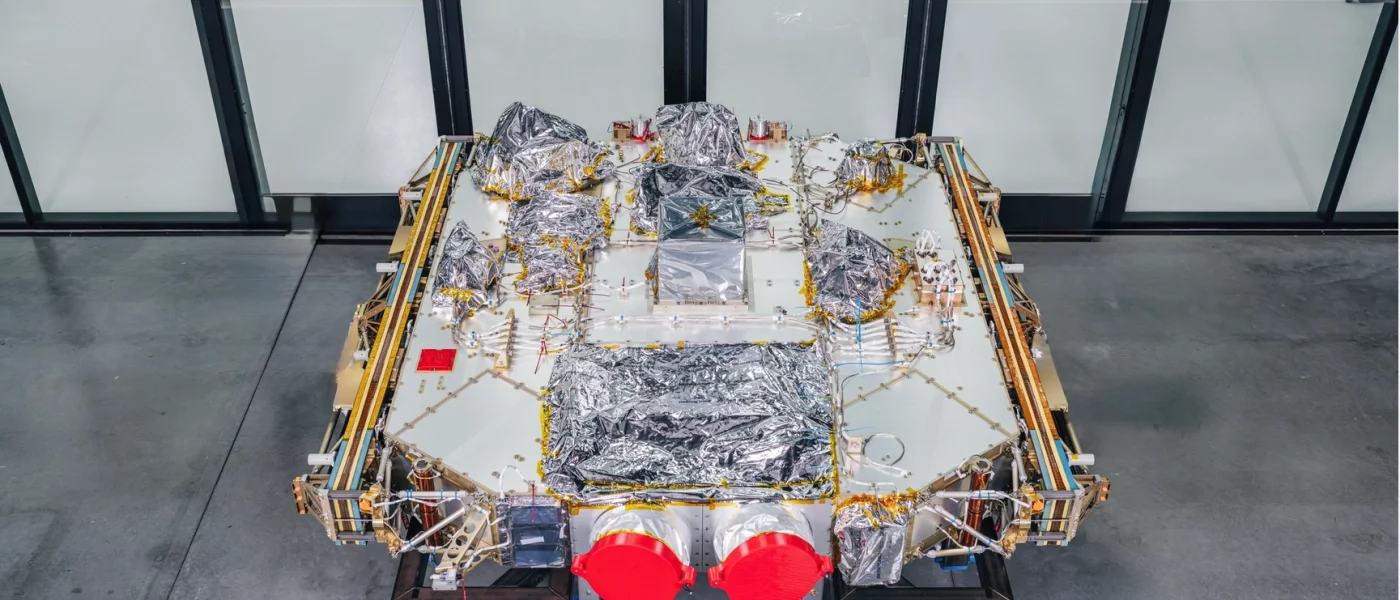
Credit: K2 Space
SES, a space solutions company, today announced it will deploy meoSphere, a next-generation medium Earth orbit (MEO) satellite network targeted for operation by 2030 and designed to significantly boost the company’s MEO network capacity.
The program launches with a close collaboration designed for efficient satellite production. SES will pair its own software-defined payloads, being developed and manufactured in Luxembourg, with an initial 28 high-power satellite platforms developed by K2 Space, representing the first phase of the broader meoSphere rollout. The collaboration gives SES tighter control over key supply-chain elements, compresses the build timeline, and allows the company to manage schedules and costs with precision, laying the foundation for future scalability.
meoSphere is SES’s next generation MEO network, significantly boosting global broadband capacity, increasing user data speeds while reducing terminal sizes and costs. These step-change improvements come from advances in payload and terminal technologies, software-defined networking, 5G non-terrestrial network (5G NTN) standards and MEO’s inherent strengths: efficient geographic coverage, ability to steer capacity to the high-demand areas, optimizing ground-station deployment, and low latency. The network is designed to meet growing demand for secure, stable, reliable, and resilient connectivity across government, mobility, and fixed telecommunications markets. The meoSphere network will be compatible with Europe’s IRIS2 program.
Orbiting at about 8,000 kilometers above Earth, SES is designing meoSphere for adaptability across new missions, new use cases, and new customer segments. Beyond its core broadband mission, the network’s flexible architecture will support multiple missions simultaneously, including integration with sovereign networks, serving governments and other customers that require sovereign solutions. meoSphere will also support the growing space economy, functioning as a space-based host for customer payloads and as a “backbone network in space” that enables interconnections between constellations in all orbits to relay data to each other and to the ground in real time.
“Space is the invisible backbone of the global data economy and national security,” said Adel Al-Saleh, CEO of SES. “Together with K2 Space and other space partners, we’re building meoSphere as essential infrastructure—constructed faster, designed to handle massive data demands globally, and built to support the secure, resilient sovereign networks that our global government allies depend on.”
“The meoSphere partnership with SES is a clear validation of K2’s mission to build the highest power satellites on orbit to realize our partners’ and customers’ ambitions in space,” said Karan Kunjur, Co-Founder and CEO of K2 Space. “We’re incredibly proud to partner in this effort with SES, a longstanding and forward-leaning space industry leader who shares our commitment to building new, efficient space architectures at speed and scale.”
Over the next three years, SES plans to launch a series of MEO “pathfinder” missions with K2 Space to test and validate the satellite bus and SES payload components in orbit, refine operational concepts, and reduce risk ahead of full-scale deployment. Each mission will carry progressively greater payload complexity, incorporating lessons learned from earlier flights into the development cycle.
This announcement builds on SES’s collaboration with K2 to develop a next generation MEO network. This initiative is included in the company’s previously-announced capital expenditure guidance for full-year 2026 and is expected to conform to SES's financial policy of disciplined capital deployment. The company is committed to using a disciplined mix of commercial and public-private approaches to mitigate financial risk. In addition, SES intends to maintain a dual supply chain across the Atlantic to strengthen resilience against potential constraints in parts availability, permitting, and logistics.
Designed for continuity, built for confidence
meoSphere is engineered for customers whose operations cannot afford uncertainty — where connectivity failures have real-world consequences and performance must be guaranteed.
For government and defense customers, that means command-and-control communications that are resilient in contested environments. MEO's orbital geometry offers inherent resilience: a smaller number of widely-spaced satellites presents a fundamentally different threat profile than dense low-orbit constellations, while the network's transparent payload architecture allows sovereign customers to operate their own waveforms and modems including in the “military Ka-Band" spectrum range, preserving the security and independence that classified and sensitive missions require. Space-based routings via optical intersatellite links (OISLs) ensure traffic always lands in secure gateways.
For mobility customers in aviation and maritime, meoSphere will deliver fiber-equivalent throughput to support passenger connectivity, crew communications, and operational systems, simultaneously across ocean routes where coverage gaps are not an option. For commercial aviation, its combination of high throughput and low latency is built to perform at scale. meoSphere's flexible design will enable SES to offer mobility clients multi-orbit solutions in combination with LEO and GEO.
For telecommunications operators and enterprises, meoSphere will offer a high-performance connectivity layer based on a 5G-NTN network suited to customers seeking path diversity and extended network reach.
How meoSphere is built: architecture and the K2 Space platform
meoSphere is a multi-mission space network built for government and commercial customers that require a high degree of security, control, reliability and resilience.
The architecture is optimized to take advantage of inherent strengths of the payload and bus: the high-power K2 Space satellite bus, which handles power, propulsion, flight control, and other foundational platform systems; and the digital regenerative SES payload, which carries the mission equipment—radios, processors, and antennas—to connect users and networks on the ground. By developing payloads and related software in-house, SES can apply repeatable design and test methods to accelerate batch production and maintain direct oversight of the performance characteristics that matter most to customers.
meoSphere architecture will allow SES to scale the network over time beyond the first 28 satellites. Scaling of the network will be determined by market demand.
meoSphere specifications
Architecture
8,000 km altitude
4 inclined orbital planes, 7 satellites per plane (for Phase 1) for global pole-to-pole coverage
High-Power Platform, significantly more than previous generations
Each satellite delivers 20 kW of power, significantly higher than previous generations.
Long-Duration Mission Design
Equipped with twin thrusters to support extended mission life and manoeuvrability.
Flexible, Multi-Mission Bus
K2’s satellite bus supports multiple payloads and mission types, including hosted payloads, sovereign network functions and in-space data connectivity.
Optical Intersatellite Links (OISLs)
Enable direct satellite-to-satellite communication.
Interoperable with other constellations and space-based missions.
Provides enhanced network resilience and faster space-to-ground relay.
Optical Networking for Ultra-Fast Relay
Supports up to 100 Gbps optical data relay for:
meoSphere satellite crosslinks
Direct-to-device (D2D) missions
Earth observation data relay
LEO constellations data relay
Space stations and orbital data centers
Edge Computing & Storage: Enables local processing of data for analytics and AI workloads
Offers ultra-secure storage for sovereign data management
Reduces dependency on ground infrastructure by avoiding downlink-first workflows.
User Access & Terminals
Up to 1 Gbps using flat panel electronically steerable antennas (ESAs).
Up to 4 Gbps using parabolic antennas for trunking applications.
Terminal Options: Standard 50 × 50 cm and 25 × 25 cm ESAs to be available for governmental, mobility, and fixed data applications.
5G-NTN and 3GPP Compliance: Ensures seamless integration with terrestrial mobile networks and other NTN systems.