Celestia Callisto Innovations in Low Noise Amplification for Ground & Space Presented at the 40th Annual Small Satellite Conference
Operators seeking the best solutions in low noise amplification can find out how experts like Celestia Callisto, with a thirty-year track record in radio frequency and cryo technologies behind it, can push the limits of their ground or space business by visiting them at the 40th annual Small Satellite Conference in Salt Lake City this year, 23rd-26th August 2026.
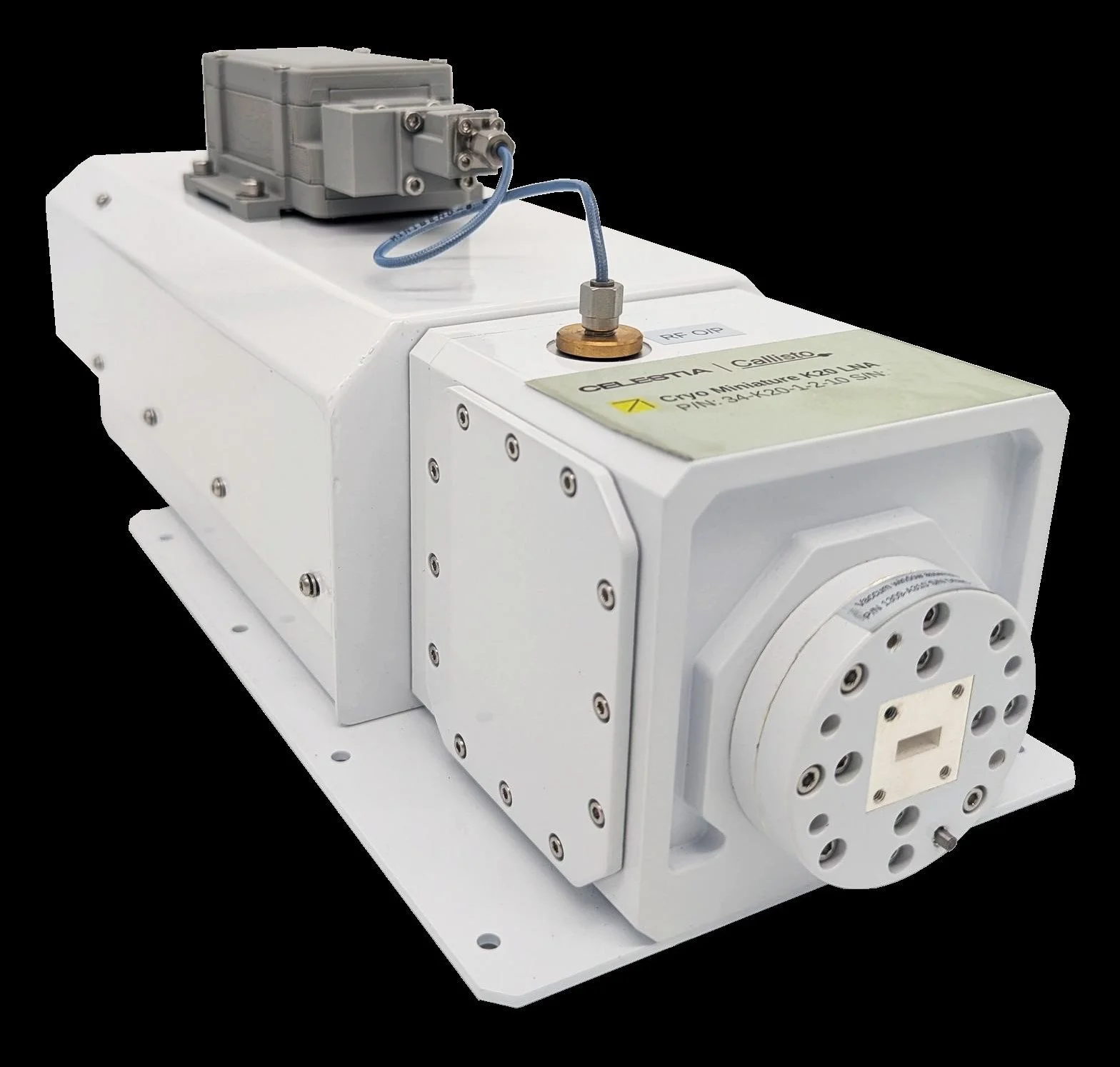
Innovations tailored for low noise amplification for smaller or mid‐sized antennas will take pride of place on the company’s booth C34, at the conference, including its Compact Cryogenic Low Noise Amplifier (LNA), which represents a breakthrough in low noise performance for ground and space communications.
The Compact Cryo LNA uses a robust, highly compact design featuring an integrated cryo cooler to achieve seamless, ultra-low noise amplification in a wide range of applications from earth observation and radio astronomy to lunar communications.
The Compact is fully self-contained, avoiding the need for an additional compressor, gas lines or water chiller, so there are no liquids to top off and fewer working parts than other cryogenic systems on the market. This means it can offer up to 10 years of maintenance-free operation with low energy consumption suitable for any antenna starting at 6-metres in diameter. It also runs in any orientation on single or dual channel on multiple frequency bands from S to KA32 and can be mounted in redundant configurations.
“We call our Compact Cryo LNA the ‘simple cryo’ because of its unique, self-contained design and small footprint,” says Jennifer Bernard, Commercial Manager, Celestia Callisto. “That’s because its simplicity is actually the key to its exceptional performance, efficiency and reliability,” she says. “Not only does it provide outstanding low-noise amplification for any application on the ground alongside running maintenance-free for up to a decade, it also boosts operations in other ways.
“Signal improvement from our Compact means you can reduce your antenna size by 20% or more and benefit from lower CAPEX and easier deployment. By increasing sensitivity, you can either improve link margin or down‐size the antenna system and see a corresponding decrease in costs. For a 10-metre earth observation antenna, that could mean a cost saving of around 150K€ in materials for the dish, structure and pointing system.
“Smaller or mid‐sized antennas that might not previously have been able to justify a cryogenic system can now embed a compact LNA to enhance performance without the cost or size of a large system,” she continues. “Our Compact is also ideal for a retrofit or refurbishment of an older antenna design to get maximum performance.”
Operators with antennas starting at 2 metres in diameter can now rely on innovations such as Celestia Callisto’s new Cryogenic Mini LNB to enhance their ground station performance. Known simply as ‘The Mini’, it was designed to deliver the exceptional signal sensitivity of a cooled LNA in an unprecedented compact form factor.
Engineered for extended Ka band (17.7–21.2 GHz), it weighs under 5 kg and achieves a noise temperature of less than 55K, even under elevated ambient temperature conditions, as validated by sister company Celestia TTi. Powered by a compact Stirling cryocooler, the Mini is entirely self-contained, requiring no external cooling infrastructure and operating autonomously without intervention.
“Our team of experts relied on their end-to-end engineering capability to develop The Mini, making very precise RF design choices at every stage to achieve a sub-55K noise temperature in a sub-5 kg package, across the full Ka band,” continues Jennifer Bernard. “The result is exceptional reception in a fully self-contained system with additional benefits of reliability and cost-effectiveness for smaller antennas, even in the most punishing of environments.”
Details of these and other innovations in cryogenic front-ends for ground stations are available from the Celestia Callisto booth C34, at the Small Satellite Conference, Salt Lake City, Utah, USA, this year, 23rd-26th August 2026.